Hobart crack willow removal project
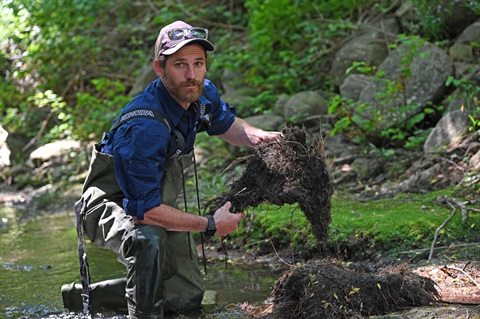
We are working to rid Hobart's rivulets and catchments of the crack willow (Salix fragils).
The crack willow is a highly invasive environmental weed. It damages the environment, and creates added risk to major flood events.
The project is expected to run for three years.
The $1.1 million is being equally funded by the City of Hobart and the Australian Government through the Disaster Ready Fund. It is administered by the Tasmanian Government Department of Premier and Cabinet.
Why this project is important
Crack willows choke inland waterways. They forms impenetrable thickets that lead to flooding and bank erosion. This increases the risks to people, homes, businesses and infrastructure during major flood events.
Crack willow is also a highly invasive environmental weed. Its roots spread throughout waterways, pushing out native trees and shrubs, reducing oxygen available for fish and other aquatic wildlife. They make it hard for platypus to forage for food and create burrows.
This project will reduce the risk and harm of major flood events to people, nature, built infrastructure and businesses. It will also lead to a more resilient community better prepared for and protected from major flood events.
The project builds on earlier willow tree eradication work along the Hobart Rivulet. It greatly expands the scope of willow tree removal across the entire Hobart catchment.
Stage 1: Hobart Rivulet
Our crack willow removal project was launched in October 2024. We have made great strides ridding the Hobart Rivulet of this environmentally damaging weed.
Removing crack willows is painstaking work. So far we have treated almost half the 277 individual trees earmarked for removal along the Hobart Rivulet. We have also removed 28 individual trees.
That list doesn’t include the hundreds of very small saplings hand pulled from the rivulet.
If we could cut and stack all of the crack willows removed from the Hobart Rivulet so far under this project and weigh them on a giant set of scales, they'd come in at more than 75 tonnes of dead wood and debris.
We are now on schedule to plant 100 native trees along the lower Hobart Rivulet, replacing the crack willows removed from that area.
Upstream near the Guy Fawkes Rivulet we plan to put another 220 native trees, mid-story species and ground cover in the ground.
We're grateful for the help of the Australian Platypus Conservancy and local platypus advocate Pete Walsh for their help ensuring we keep platypus safe during this project.

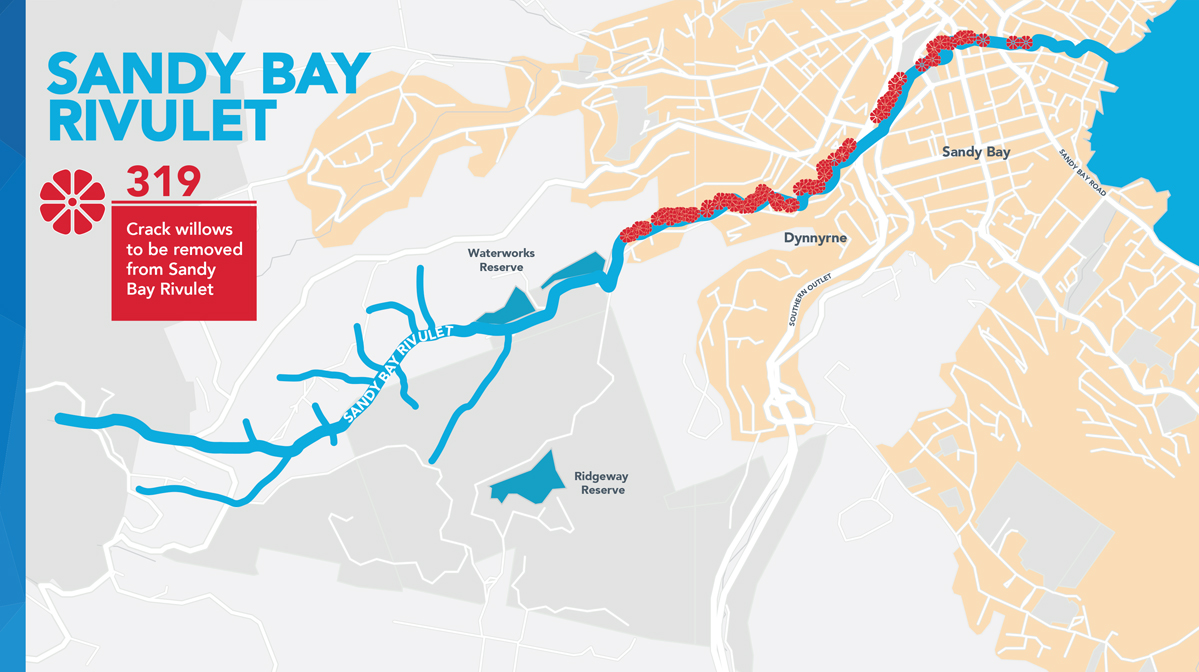
Stage 2: Sandy Bay Rivulet
Project progress and delay
The second stage of the Sandy Bay Rivulet operation, which was initially scheduled to be underway at this time, has experienced a delay.
This delay is due to the identification of critical water infrastructure in the upper project area that may be at risk of damage from machinery. To address this issue, we are currently collaborating with TasWater to determine the necessary restrictions and precautions before proceeding with further works.
Revised Timeframe
We are committed to undertaking the works in this area, we will be able establish a timeframe for these works when we have finalised details with TasWater and established removal mechanisms with contractors. We will continue to update this website with information as it is available.
If required we may be in touch with individual property owners to discuss options.
Revegetation and replacement trees
As originally planned, revegetation activities will take place following the completion of removal works.
We will either plant the replacement trees you requested through our engagement process, or assist you in planting them if needed. If you did not specify your preferences for replacement trees, suitable species will be selected on your behalf.
Gallery