
We are holding a special free garden party to celebrate the hundredth anniversary of St David's Park in Hobart.
Join us in front of the park's beautiful rotunda for Devonshire tea and old school tunes played by a brass band.
Tables and chairs will be set out around the rotunda, and actors in period costume will transport us back in time.
The garden party is a great opportunity for a stroll beneath St David's beautiful trees, which include funeral cypress dating from the time the park was a cemetery, towering English elms, and Canary Island date palms, rare in Hobart and part of the original Lipscombe planting.
Or explore the wall of headstones, a reminder of life and death during the early days of the Hobart colony.
The lion sculptures at the park entrance are also worth a visit. A bicentennial gift to the people of Hobart from the Australian and New Zealand Banking Group Limited in 1988, they were originally carved by Richard Patterson in 1884 as guardians to the Bank of Van Diemen’s Land building.
The garden party will be held on Friday 13 November 2026 and starts at 10am and finishes at 1pm.
It will include a ceremonial planting of two young giant sequoia trees, honouring the two sequoias lost earlier this year.
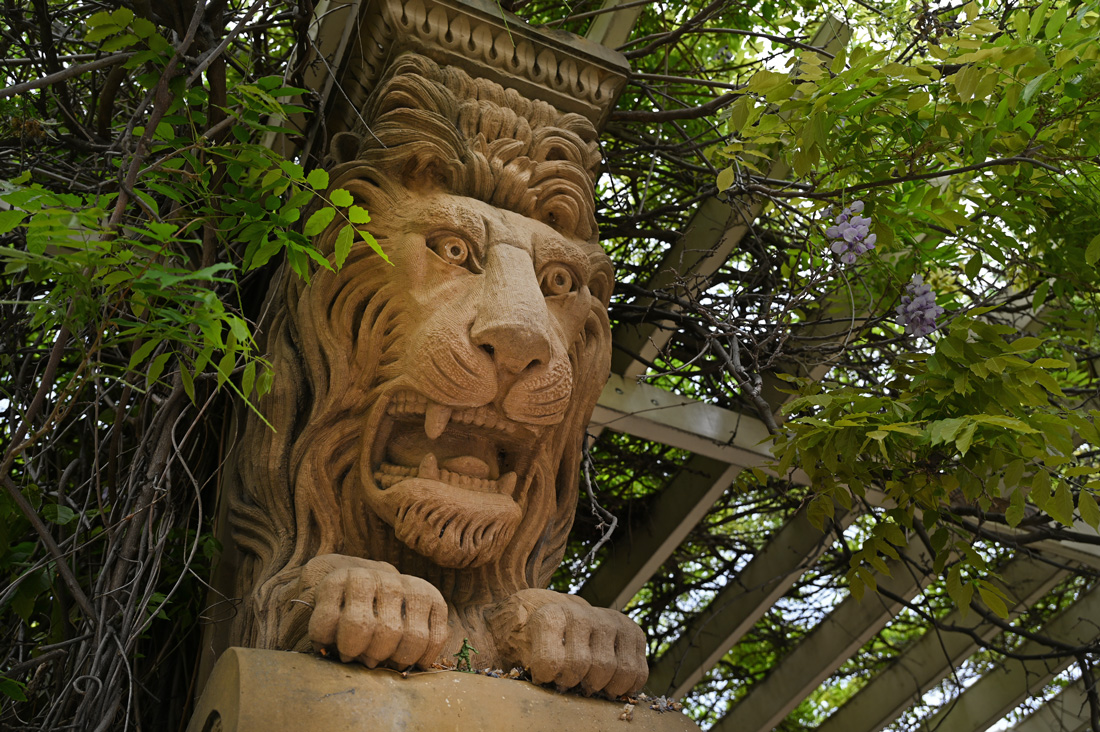 Richard Patterson's sculptured lions guard the entrance to St David's Park.
Built on old bones
Designated a cemetery in 1804 by Reverend Robert Knopwood, what is now known as St David's Park occupies the site of Hobart's original European burial ground.
In the 1820s St David’s Burial Ground was described as ‘a place of real seclusion and rare beauty’, located away from the main settlement and surrounded by an ‘exquisite natural shrubbery’.
Two streams ran through the grounds, with old blackwood trees standing between groves of wattle on the high ground.
But by the 1830s the grounds had become neglected and surrounded by a rapidly spreading town. By the 1850s people were becoming alarmed at the burial of bodies so close to a growing city.
The grounds continued to decline, with reports of defaced headstones, an 'odious wilderness' of choked bracken and toppled headstones.
'Undesirable characters' were thought to have evaded the local constabulary by hiding in collapsed graves.
The burial grounds were closed in 1872.
 The rotunda being built around 1926. Image: Libraries Tasmania
A park for the people
St David's Park was designed in the early 1920s by Leslie Lipscombe, Hobart City Council's first Superintendent of Reserves.
Before his death in 1928 Leslie laid out plans for Fitzroy Gardens, Long Beach Reserve in Sandy Bay, Cornelian Bay, the rose garden on the Domain and of course, his masterpiece, St David's Park.
The task of transforming the cemetery into a beautifully landscaped, formal English style walled park would be no easy task for the superintendant.
The land had to be acquired from church authorities, headstones, coffins and bodies moved, the creek beds filled in.
In November 1924 the Mercury reported that:
The City Council has decided that Hobart shall have to her credit a park worthy of the name, whose attractions will be manifold, and a place where citizens may roam at leisure, where oaks will mingle with elm and gums, and weeping willows droop their tresses over richly-verdued lawns.
Over the morbid atmosphere which has surrounded the spot for over a century will be draped an air of dim forgetfulness, for roses and climbing flowers will find their way up along the walls, where some 600 headstones are now located, and gradually veil with beautiful blooms the inscriptions made years ago.
Its long hallowed recesses beneath tall, sombre cypress pines will shortly ring with the laughter of children, and re-sound to the music of bands, to say nothing of the calls of birds that will be at-tracted by the flowers, and the trans-formation will be complete.
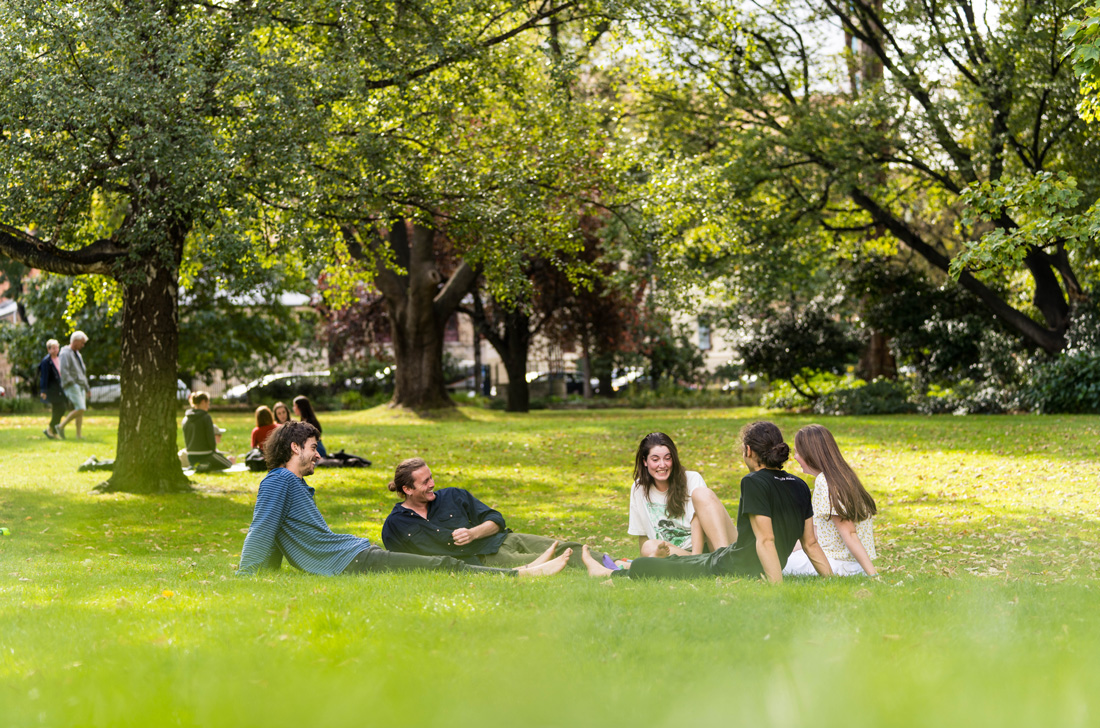 A century after it was first imagined by its creator Leslie Lipscombe St David's Park has become one of Hobart's most cherished parks.
Recognising connection to place
Although St David’s is very much a European styled park designed using trees and shrubs originating from Europe, two flowering blue gums recognise the importance of this place for Tasmanian Aboriginals.
The oldest of the two blue gums is listed on the Significant Tree register. The second was planted in 2020 at the request of the Tasmanian Aboriginal Heritage Council.
The second blue gum acknowledges the remains and spirits of their old people in the park.
It was also planted to ensure there is always one native free standing in this place.
Celebrate 100 years of our city park
On Friday 13 November 2026 the people of Hobart are invited to celebrate the hundredth anniversary of St David’s Park, Leslie Lipscombe’s masterpiece, at a special garden party.
A brass band will be playing in the rotunda, there will be Devonshire tea and roving actors in period costume.
Story sources
- The Companion to Tasmanian History
- The Mercury newspaper
- On the Convict Trail, Geoff Ritchie