The legacy of Hobart’s iconic giant sequoias will live on through a diverse range of community, cultural, educational and creative projects after the City of Hobart awarded timber from the historic trees to 25 successful recipients.
More than 60 expressions of interest were received from artists, schools, researchers, community groups and cultural organisations seeking to give new life to timber from the two giant sequoias removed from St David’s Park after they fell into decline.
The successful projects showcase the breadth of Tasmania’s creative and community sectors, ranging from Aboriginal cultural works and public art to scientific research, vocational training, furniture making and musical instruments.
Among the recipients is The Friends’ School, where students will take part in a hands-on design and technology project that follows the timber’s journey from log to finished product. The school has been allocated a sequoia log that students will transform into outdoor seating for the senior school campus.
Friends' Teacher of Design and Technology Michele Diener said the project would provide a unique real-world learning experience.
“We're going to use our log to take our students through all the stages in which timber will be processed from taking it to the sawmill ... and then designing it and turning it into usable furniture,” she said.
Ms Diener said the project would give students an opportunity to experience the processes they typically only learn about in the classroom.
“They'll get to see a log in its raw form,” Ms Diener said.
“They'll get to see how it's cut down and then get their hands on it and see how it gets seasoned.
“There's so many different elements of just things that we try and express to them, but they don't get to see it firsthand.”
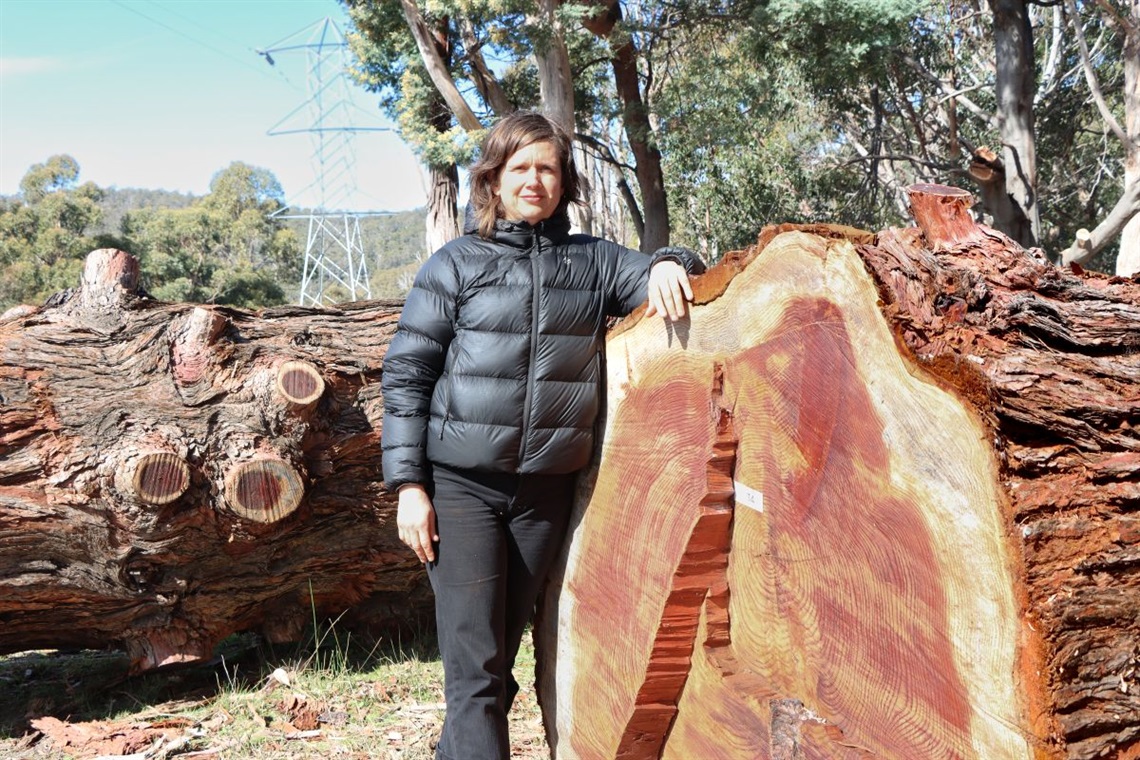
Friends' Teacher of Design and Technology Michele Diener and Hobart Lord Mayor Anna Reynolds inspecting the school's allocated giant sequoia timber.
The Friends’ School project is one of several education-focused initiatives selected through the program. Elizabeth College construction students will build picnic tables, while Claremont College will create hospitality classroom tables that showcase the educational value of the timber.
Elsewhere, the timber will support vocational training and wellbeing programs. The Tasmanian Prison Service will use the sequoia timber for woodworking projects that provide inmates with practical skills and rehabilitation opportunities, while the Defence and Veterans Workshop will deliver projects aimed at wellbeing, connection and skill development for veterans.
The material will also be transformed into Aboriginal cultural objects, including clapsticks, spears and coolamons, while artists and makers will create everything from jewellery and sculptural lighting to public play sculptures, carved puppet portraits and commemorative works.
The project extends beyond the arts, with researchers set to investigate atmospheric radiocarbon records preserved within the trees’ growth rings, ensuring the sequoias contribute to scientific knowledge as well as community outcomes.
Timber collection has now begun, with projects expected to take shape over the coming months and years.
Hobart Lord Mayor Anna Reynolds said the strong response reflected the community’s affection for the trees and its desire to preserve their story.
“Many Hobartians told us how saddened they were about the loss of the sequoia trees from St David's Park, but it's so wonderful that we've got this amazing legacy that's been created for these two trees through this project.”
“We received 60 expressions of interest from so many different organisations and artists and schools and public institutions and we've been able to award 25 different projects with free timber from the sequoias and these wonderful projects will be an ongoing legacy to these wonderful trees of Hobart.”