Giant sequoias in St David's Park

We have removed the two giant sequoias in St David's Park that have been in decline since autumn 2025.
The dead trees did not pose an elevated risk to the public, however, if left in place, their condition would have continued to decline and create an increasing risk over time.
Removing the trees was a complex operation, requiring a large team as well as specialist equipment to ensure the works were carried out safely and carefully.
Given the special connection these trees have to many in the community, an Expression of Interest process is now underway to gather ideas on how the timber can be used.
Expressions of Interest
Trees in decline
After showing deep signs of distress since Christmas the two giant sequoias in St David’s Park failed to respond to repeated attempts to revive them.
We have been hoping for the best, but preparing for the worst, and have worked closely with professional arborists to determine the full state of the trees’ illness.
The decline of the giant sequoias is likely due to a combination of multiple impacts over the past two years, including repeated fires reaching the canopy, contaminants and fire‑retardant foam entering the soil, removal of topsoil to address hazardous debris, soil compaction, irrigation leaks causing saturation and the presence of fungal pathogens.
Two young sequoia trees will be planted in the place of the older trees later this year as part of centenary celebrations of St David's Park.
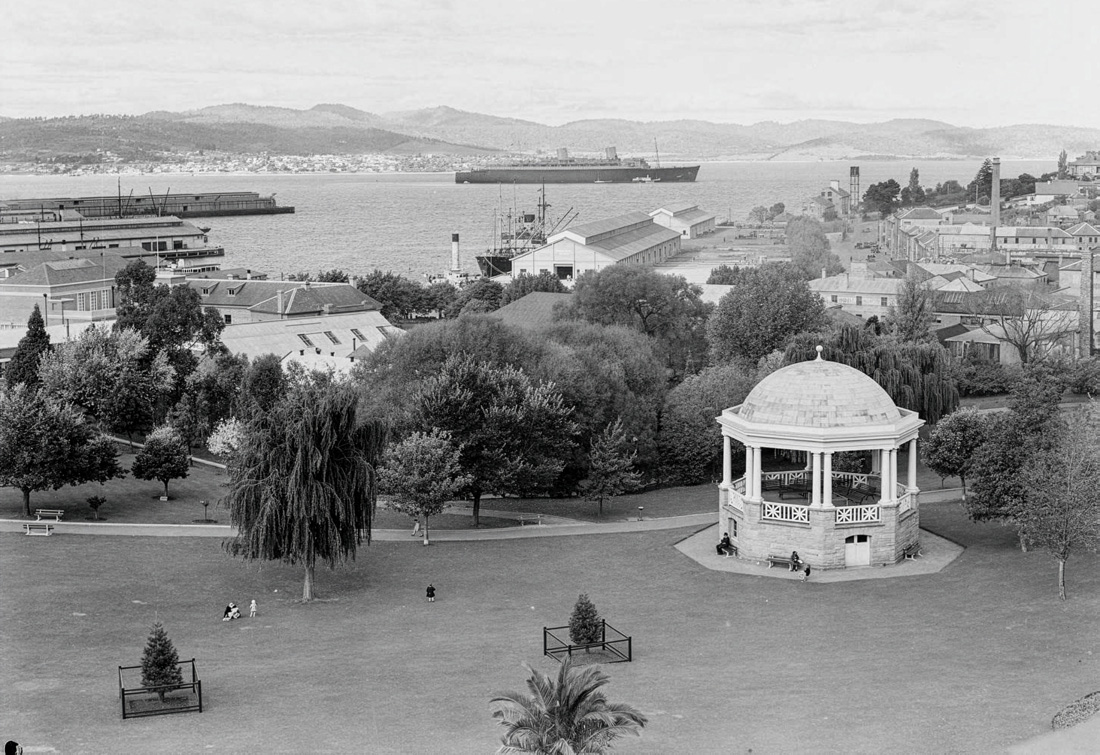
The two giant sequoias in St David's Park, early 20th century.
Coronation
The trees were planted in St David's Park in 1937 to commemorate the coronation of King George VI and Queen Elizabeth.
At just 88 years of age, these trees are barely out of their cradle. Giant sequoias are incredibly long-lived, holding on to life for more than 3000 years. They are true ancients of the tree world.
Both giant sequoias in St David's Park are listed on the National Trust and are of state significance.
We know that many generations of Hobartians have fallen in love with these trees. Children have delighted in their strong, broad limbs and so many of us have developed a deep connection with these tree giants.
Frequently asked questions
What is the cause of the trees' demise?
- There is no single cause for the decline of these giant sequoias, but both trees have suffered multiple impacts over the past two years, including:
- fires below and up into the canopies
- contaminants melting into the soil beneath the trees during the fires and fire retardant foam used to extinguish the fire also entering the soil
- removal of topsoil to clean out contaminated debris that posed a significant public safety risk
- soil compaction from pedestrian and vehicle use
- irrigation leaks contributed to soil saturation, and
- fungal pathogens present in both trees.
What attempts have been made to save the trees
- We have been working to improve the soil health beneath the two trees by increasing soil microbiology. We also removed the garden beds from below the canopies to give the underground root system the best chance to recover.
Are the trees heritage listed?
- These two giant sequoias are not listed on the Significant Tree List of the Tasmanian Planning Scheme. St David’s Park is a listed Heritage Place and so we have applied for, and received approval from Heritage Tasmania, to remove the trees.
- The trees are listed on the National Trust Register as specimens of State Significance and the National Trust has been kept informed of plans to remove the trees.
What will happen to the wood from the trees?
- Most of the wood from the two trees will be stored to let the timber cure after the two trees were removed from St David's Park in May 2026. During that time we will gather ideas about how the timber can be used both by the City and other partners, ts, focusing on utilising the wood in a manner that gives back to the Hobart community.
- Woodchips will go to McRobies Gully Tip and be used to create compost and green waste.
What will be planted to replace the two trees?
- We will replant two trees of the same species in St David’s Park.
When will replacement trees be planted?
- It will take some time to remediate the site once the two dead trees are removed, but we intend to have the two new trees in the ground before the 100 year celebration of St David’s Park later this year.
Do the two trees pose any public safety risks?
- In the short term branches on dead trees tend to be stronger than live, green branches. Only when wood-decaying fungi start eating away at a dead branch does its structural integrity decline. We would expect that to be 12-18 months from the time the tree died.
How old are the trees?
- The trees are 89 years old – they were planted in 1937 to commemorate the coronation of King George VI and Queen Elizabeth.
How big are these trees?
- The giant sequoia closest to Davey Street is 8.62 metres in girth at ground level and 32 metres tall. It is estimated this tree stores just over 70kg of carbon each year.
- The second giant sequoia is 8.7 metres in girth at ground level and 30 metres tall. It is estimated this tree stores just over 70kg of carbon each year.
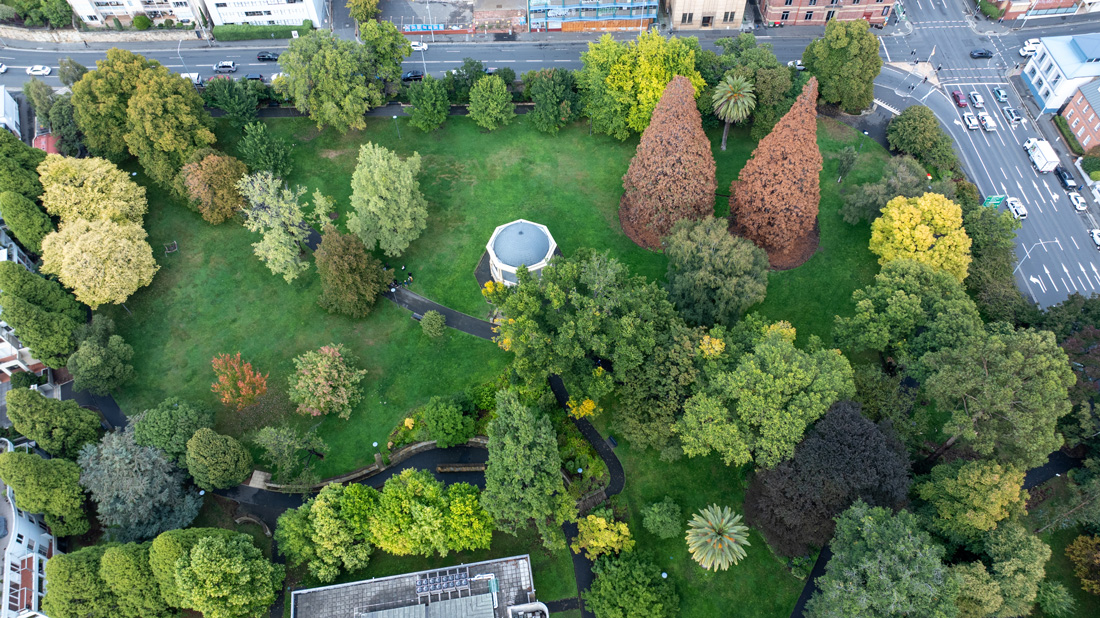
An aerial photo of the giant sequoias taken in late March 2026.

The yellowing needles on one of the giant sequoias just before Christmas were a sign of severe distress.