Hobart crack willow removal project
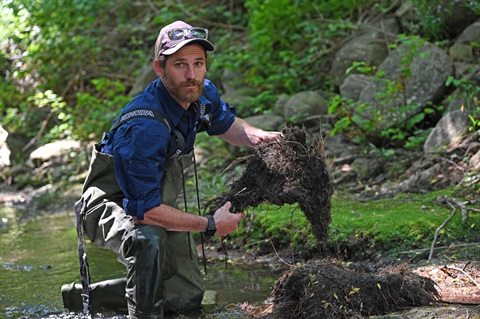
We are working to rid Hobart's rivulets and catchments of the crack willow (Salix fragils).
The crack willow is a highly invasive environmental weed. It damages the environment, and creates added risk to major flood events.
The project is expected to run for three years.
The $1.1 million is being equally funded by the City of Hobart and the Australian Government through the Disaster Ready Fund. It is administered by the Tasmanian Government Department of Premier and Cabinet.
Why this project is important
Crack willows choke inland waterways. They forms impenetrable thickets that lead to flooding and bank erosion. This increases the risks to people, homes, businesses and infrastructure during major flood events.
Crack willow is also a highly invasive environmental weed. Its roots spread throughout waterways, pushing out native trees and shrubs, reducing oxygen available for fish and other aquatic wildlife. They make it hard for platypus to forage for food and create burrows.
This project will reduce the risk and harm of major flood events to people, nature, built infrastructure and businesses. It will also lead to a more resilient community better prepared for and protected from major flood events.
The project builds on earlier willow tree eradication work along the Hobart Rivulet. It greatly expands the scope of willow tree removal across the entire Hobart catchment.
Stage 1: Hobart Rivulet
Our crack willow removal project was launched in October 2024. We have made great strides ridding the Hobart Rivulet of this environmentally damaging weed.
Removing crack willows is painstaking work. So far we have treated and/or removed 154 of the 227 crack willow trees we are targeting in this catchment.
That list doesn’t include the hundreds of very small saplings hand pulled from the rivulet.
If we could cut and stack all of the crack willows removed from the Hobart Rivulet so far under this project and weigh them on a giant set of scales, they'd come in at more than 75 tonnes of dead wood and debris.
We have planted back 265 native plants along the lower Hobart Rivulet, replacing the crack willows removed from that area.
Treatment and removal of the remaining crack willows in this catchment is planned for spring and summer 2026.
Upstream near the Guy Fawkes Rivulet we plan to put another 220 native trees, mid-story species and ground cover in the ground.
We're grateful for the help of the Australian Platypus Conservancy and local platypus advocate Pete Walsh for their help ensuring we keep platypus safe during this project.

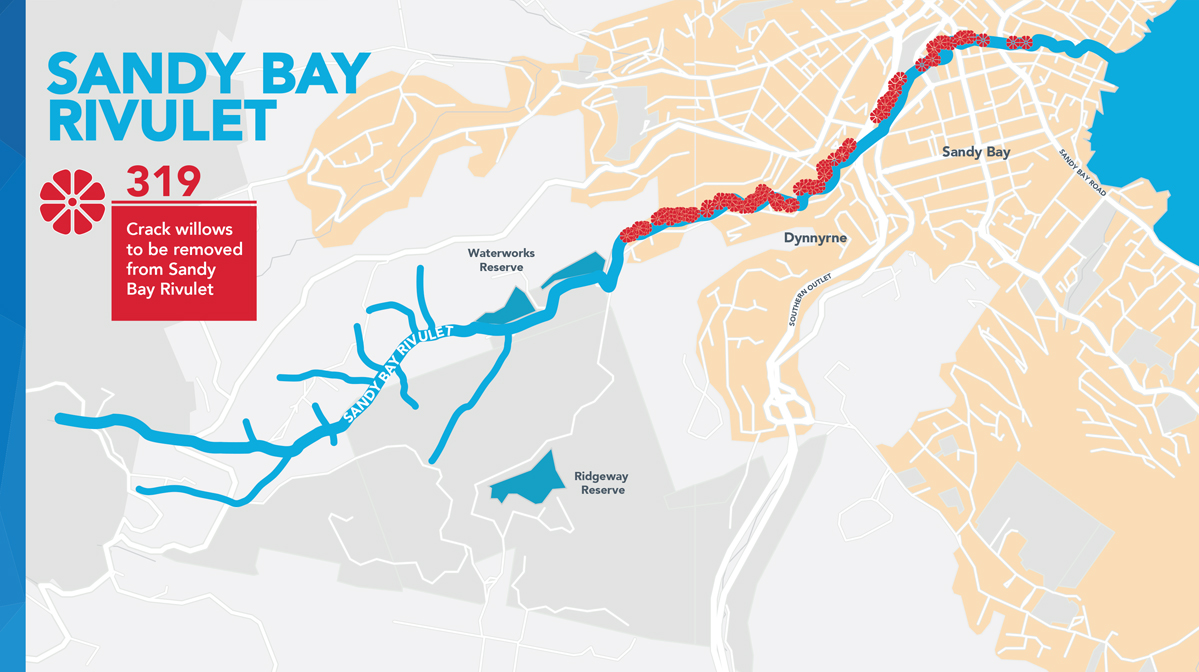
Stage 2: Sandy Bay Rivulet
Project progress and delay
Stage two of our plan to remove crack willows from the Sandy Bay Rivulet has hit a slight snag.
We are working closely with TasWater to resolve the issue, allowing us to continue with our project while ensuring critical water infrastructure in the area is not damaged by heavy machinery.
So far 195 crack willows have been treated ahead of removal. Fifty of the willows are being removed using an English Reeves System due to access difficulties.
Removing crack willows from the Sandy Bay Rivulet is part of a three year project to rid our rivulets of this environmentally destructive species.
Stage one of the Sandy Bay Rivulet removal included using a safe herbicide to kill the willow trees before removal.
Stage two will be the removal of the dead trees from private properties as well as adjoining bushland.
We will reach out to all individual property owners impacted by this project as soon as we have a revised timeframe for removing willow dead trees from their property.
Revegetation and replacement trees
As originally planned, revegetation activities will take place following the completion of removal works.
We will either plant the replacement trees you requested through our engagement process, or assist you in planting them if needed. If you did not specify your preferences for replacement trees, suitable species will be selected on your behalf.
Trees for our tawnies
In July and August 2026 we will be removing all large crack willow trees between Anglesea and Weld streets along the Hobart Rivulet.
We are also:
- Planting locally native trees with South Hobart Primary School and The Friends’ School as part of this year’s National Tree Day celebrations.
- Working closely with the Hobart Rivulet Bushcare group to remove other environmental weeds and protect platypus habitat.
- Planting more native plants as part of a special new project later this year.
Trees for tawnies
We are retaining one large willow tree for the family of tawny frogmouths who have made their home by the rivulet.
Tawnies are nocturnal birds that sit still all day, hiding from predators and mimicking dead tree branches for camouflage.
Gallery